Catch Power Hot Water Diverter
Every day your solar system makes more power than your house uses. Right now that surplus goes back to the grid for a feed-in credit of a few cents. Then, usually overnight, you buy power back at four or five times the price to heat your hot water tank.
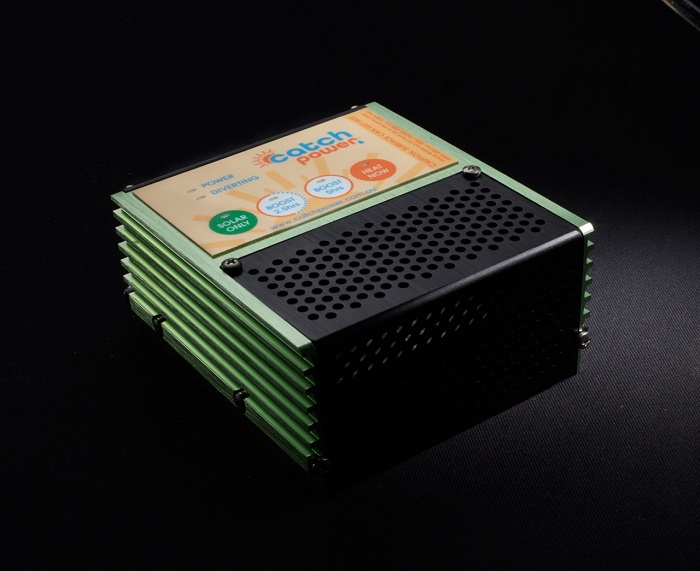
A Catch Power Control stops that happening. It sits in your meter box, watches power leaving your property, and the moment it sees surplus it sends it to your hot water tank instead of the grid.
Hot water is typically the single biggest electricity load in an Australian home. A diverter turns it into something you no longer pay for.
How a solar diverter actually works
The Catch Power Control installs in your meter box, in place of the standard smart meter that comes with a Fronius or Sungrow inverter. Two current transformers clip around your mains and measure power flowing in and out of the property.
When your solar is producing more than the house is using, the Control detects power heading out to the grid and switches your hot water element on instead. It matches what it sends to what’s actually spare, so it never pulls from the grid to do it.
When a cloud comes over or the kettle goes on, it backs off immediately. Your hot water only ever heats on genuinely surplus solar.
If the sun hasn’t done enough by the end of the day, you can set it to top up from your normal off-peak tariff so you’re never left with a cold shower. That’s adjustable — some households set it to never use mains power at all, which works well if you’re away or have a big tank.
Diverter, heat pump, or solar hot water? An honest comparison
We get asked this constantly, and the honest answer is that it depends on what you’ve already got on the wall.
| Catch Power diverter | Heat pump | Solar hot water | |
|---|---|---|---|
| Upfront cost | A few hundred dollars | Several thousand | Several thousand |
| Energy efficiency | Standard resistive element | Best — uses roughly a third of the energy | Good, but weather dependent |
| What it runs on | Surplus solar you’d otherwise export for a few cents | Grid or solar, still needs to be paid for | Direct sunlight, with electric or gas boost |
| Moving parts | None | Compressor and fan — servicing, and some noise | Pump, roof plumbing |
| Roof work | None | None | Collectors and plumbing on the roof |
| Best if… | You have solar and a working electric tank | Your tank is dying anyway, or you have little solar surplus | You’re building new and want it designed in |
The efficiency argument cuts both ways. A heat pump genuinely uses about a third of the electricity to heat the same water — that’s not marketing, it’s physics. But a diverter runs on energy you’re currently giving away for a few cents a kilowatt-hour. Being three times more efficient with power you paid for isn’t necessarily better than being ordinary with power that’s free.
Our rule of thumb: if you already have solar and your electric tank is working fine, a diverter is almost always the better spend. It costs a fraction as much, there’s nothing to break, and it pays for itself in months rather than years.
What you'll actually save
Here’s the maths, with the assumptions visible so you can check them against your own bill.
| Hot water use, household of four | About 10 kWh a day |
| What you currently pay for it (controlled load) | 20c/kWh* |
| What that surplus solar earns you instead (feed-in) | 5c/kWh* |
| Days per year the surplus covers the tank | Roughly 60–75% — less in winter, nearly all summer |
| Typical annual saving | $300–$600 |
| Payback on a new install | Months, not years |
Three things move that number. The size of your solar system, more surplus means more days the tank heats for free. When you use hot water, a household that showers at night and reheats overnight benefits most. Your tariff, the bigger the gap between what you pay for power and what you’re paid for exporting it, the faster this pays back. That gap has been widening for years.
*Estimated Figures
Made two hours up the road
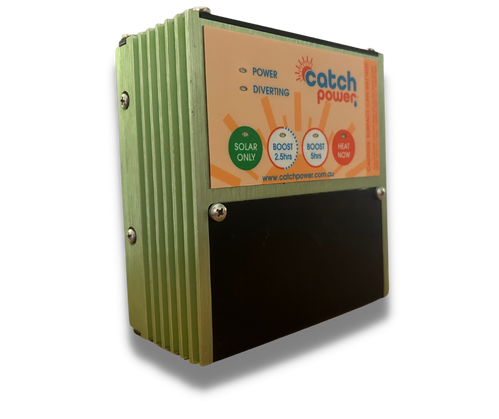
Catch Power started in 2015 in Glen Innes, up the Waterfall Way through Ebor and Hernani, in the same New England high country we service. The units are designed and manufactured in Australia.
That matters more than it sounds. When a device fails, the difference between an Australian manufacturer with local support and an importer with an email address is the difference between a warranty claim taking a week and taking a season. We’ve been installing these long enough to know which one you get.
Catch Power has also acquired Solar Analytics, the monitoring platform, and folded that capability into the Control unit — so you’re getting proper energy monitoring alongside the diversion, not just a dumb switch.
Every unit carries a five year warranty once it’s registered.
Will it work with my system?
You’ll need two things: a solar system that regularly produces more than the house uses, and an electric storage hot water tank with a resistive element. That covers most homes across the Coffs Coast and the hinterland.
Inverter compatibility. The Catch Power Control is designed to sit in place of the smart meter on Fronius and Sungrow systems,
If you already have solar, we can usually retrofit it. What matters is your switchboard layout, how your hot water circuit is wired, and whether there’s room in the meter box. Send us a photo of your meter box and switchboard and we’ll tell you before we come out.
If you’re getting solar installed with us, say so at quote stage. Adding it during the original install is far cheaper than coming back later, because the electrician is already in your switchboard.
What won’t work: gas hot water, existing heat pumps (they’re already efficient and draw differently), and instantaneous electric systems.

It does more than hot water
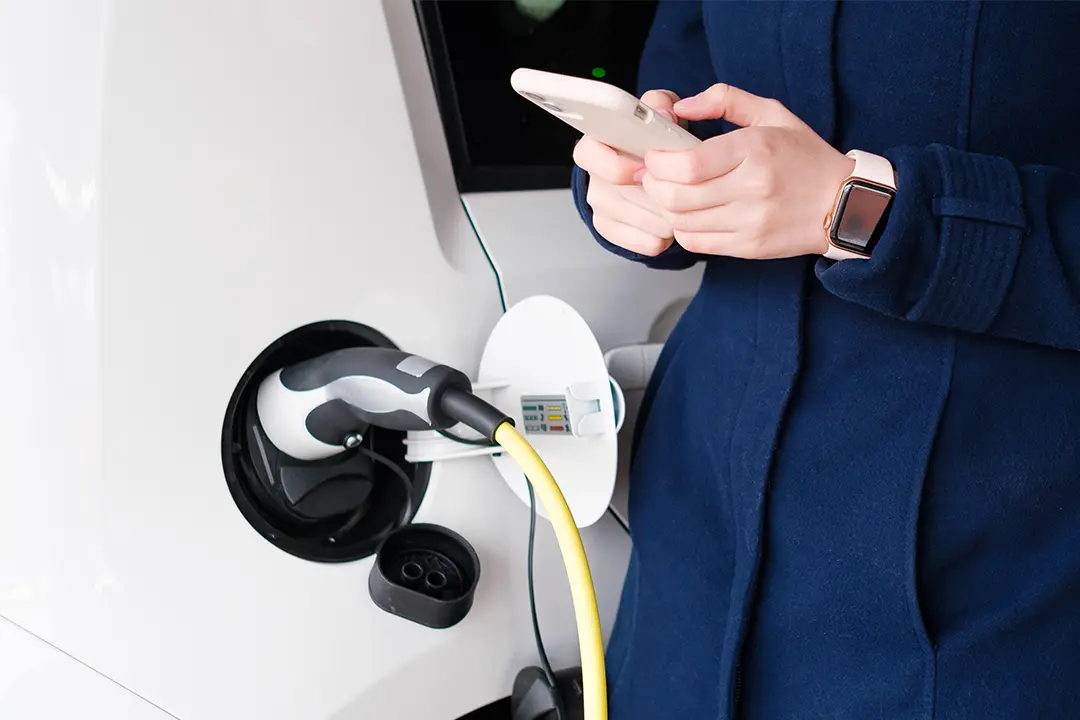
Hot water is the main job, but the Control can divert surplus solar to other loads as well.
Electric vehicle charging. Paired with a Fronius Wattpilot and a Sigenergy battery, it can charge your car from excess solar only — so the car fills up on power you’d otherwise have exported, rather than at full retail rates in the evening.
Monitoring. The Monocle app shows solar production, household consumption, battery storage if you have one, and exactly what’s being diverted where. It’s genuinely useful rather than a gimmick — most people find it changes when they run the dishwasher.
Alongside a battery. A diverter and a battery aren’t competing. The sensible order of priorities for surplus solar is: run the house, charge the battery, heat the water, then export. A properly commissioned system handles that hierarchy automatically. If you’re considering battery storage as well, we’ll set the priorities up together.
Frequently asked questions
How much will it save me?
For a household of four with an electric storage tank, typically $300 to $600 a year.
The saving comes from the gap between what you pay for power and what you’re paid for exporting it. Your hot water currently costs you the controlled load rate. Divert surplus solar to it instead and that power costs you only the feed-in credit you gave up — a few cents.
It varies with your solar system size, your tariff, and the season. We’ll estimate it properly from your actual bill rather than quoting you an average.
Is a diverter better than a heat pump?
It depends on what you already have.
A heat pump is genuinely more efficient — roughly a third of the energy for the same hot water. But it costs several thousand dollars, has a compressor and fan that will eventually need servicing, and still uses power you have to account for.
A diverter costs a few hundred dollars, has no moving parts, and runs on surplus solar you’re currently exporting for a few cents.
If you have solar and a working electric tank, the diverter is almost always the better spend — it pays back in months. If your tank needs replacing anyway, a heat pump is worth modelling, particularly given heat pumps attract their own federal incentive. We’ll run both sets of numbers.
Will it work with my inverter?
The Catch Power Control is designed to replace the smart meter on Fronius and Sungrow systems.
Most of our solar packages are built around Fronius inverters, so it fits straight in. If you have something else, send us the make and model and we’ll confirm before quoting.
Can I add one to my existing solar system?
Usually, yes. What determines it is your switchboard layout, how the hot water circuit is wired, and whether there’s physical room in your meter box.
Send us a photo of your meter box and switchboard and we can tell you over the phone rather than charging you for a site visit to find out.
Will I run out of hot water on a cloudy day?
No. You can set the Control to top up from your normal off-peak tariff if the solar hasn’t done enough by a set time, so there’s always hot water in the morning.
That setting is adjustable. Some households run it purely on solar and accept the occasional cooler shower in winter; most set a modest overnight boost as a safety net. We’ll set it up how you want it at commissioning and you can change it later.
Does it need internet or an app?
The diversion itself works without internet — it’s reading your power flow directly, not taking instructions from a server.
The Monocle app gives you monitoring and lets you adjust settings from your phone, and that does need a connection. Plenty of our hinterland customers run without it and the unit works fine.
Who installs it and how long does it take?
Our own licensed electricians. It’s meter box work, so it legally must be done by a licensed electrician — it isn’t a DIY product.
Half a day for a retrofit. If it’s going in with a new solar system, it adds almost no time because the electrician is already working in your switchboard, which is exactly why it’s cheaper to do it then.
What's the warranty?
Five years, once the unit is registered online. Catch Power is Australian owned and manufactures in Glen Innes, so warranty support is local rather than routed offshore.
We handle the registration for you at commissioning.




